


Benefits for Wellington
The specific decarbonisation pathway for Wellington will enable:
- early insights for decision makers to improve efficiency and future proof infrastructure investments
- information sharing to encourage demand flexibility through collaboration
- coordinating infrastructure and streamlining electricity demand for the future
- a full view of biomass resource availability alongside a range of practical considerations — such as regional supply, transportation, site limitations, and regulatory factors.
About the Wellington RETA
A total of 76 industrial and commercial sites are covered by the Wellington Regional Energy Transition Accelerator (RETA). These sites either have fossil-fuelled process heat equipment larger than 500 kilowatts (kW), or are sites (e.g. hospitals and schools) for which EECA has detailed information about their current energy use.
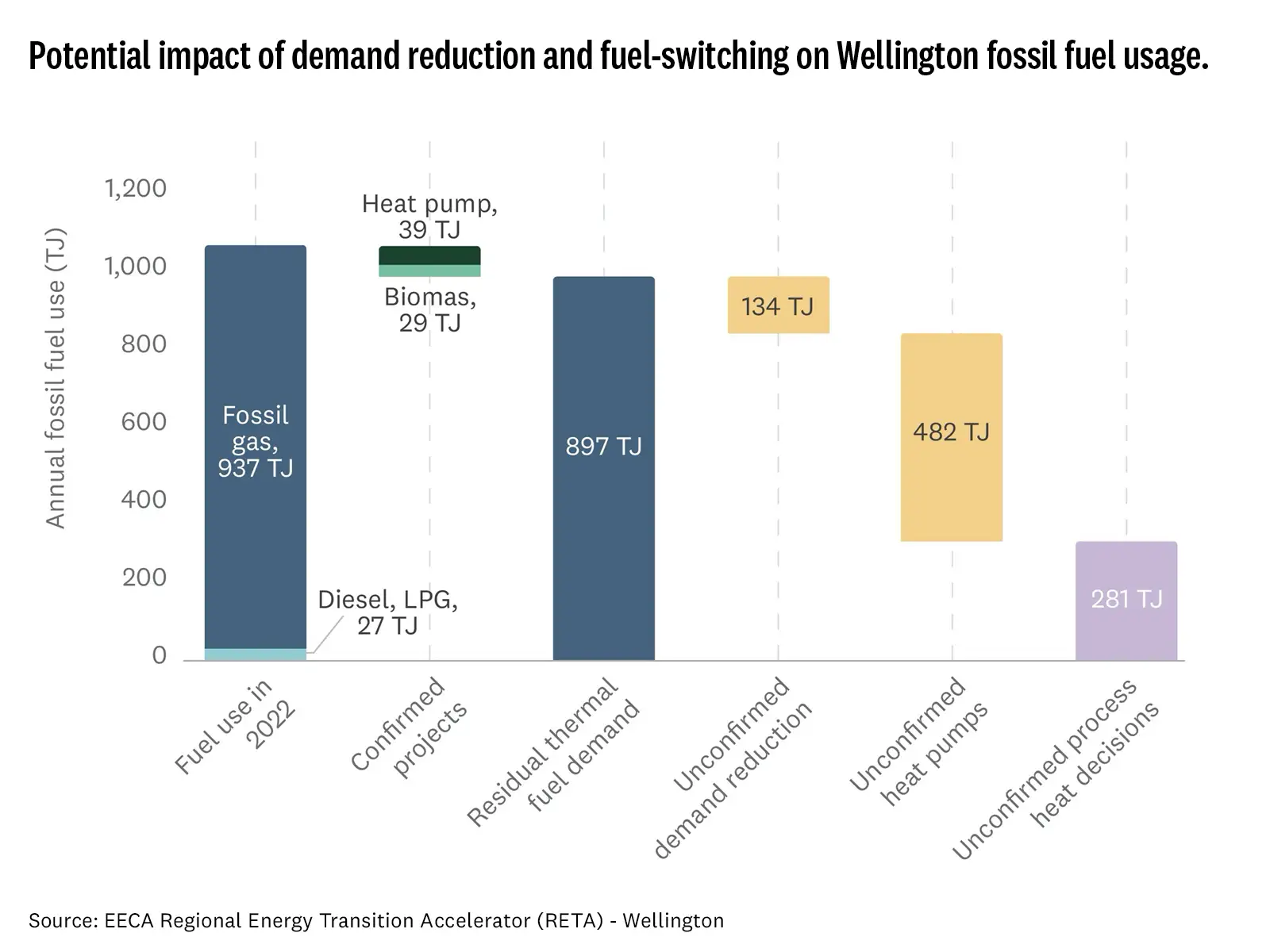
Collectively, these sites consumed 965 terajoules (TJ) of process heat energy in the baseline year 2022, primarily from piped fossil gas, producing 52 kilotonnes (kt) of carbon dioxide equivalent (CO₂e) emissions.
Almost all identified sites rely on reticulated gas, with only a small number of sites using LPG and diesel.
Wellington's emissions profile
Unlike many other RETA regions, Wellington's emissions profile is dominated by the commercial sector rather than large industrial users. Commercial buildings and institutions account for 61 of the 76 sites and 64% of the region's fossil fuel demand, largely for space and water heating.
Opportunities to reduce emissions
The Wellington report — the final regional report of the RETA programme — explores opportunities to reduce emissions through demand reduction and fuel switching to electricity and biomass. It also considers the practical implications of these pathways, recognising that Wellington's urban environment presents challenges for biomass use, including fuel transport, storage constraints and air quality considerations.
Across the Wellington sites, around 65% of current process heat emissions could be reduced through projects that are commercially attractive under expected price scenarios over the next 5 years.
The marginal abatement cost (MAC) optimal pathway would reduce process heat emissions by 82% by 2048 through a combination of 48 large heat pumps and 12 biomass boilers.
Investment in demand reduction could reduce process heat demand by around 15%, avoiding an estimated $30 to $32 million of electricity and biomass infrastructure while reducing the capacity of new fuel-switching infrastructure required.
Insights explored in the Wellington report
- The forecasts and mapping of regional stationary heat energy demand alongside renewable energy supply assessments.
- How the pathways are sensitive to changes in fuel prices.
- The importance of complementary strategies such as energy demand reduction, load flexibility, and the use of energy storage technologies to manage peak usage.
- Timeframes for different pathway scenarios:
The business as usual or ‘BAU’ pathway, which uses actual project timing or, for the majority of projects where timing is not known, is the slowest path.
The ‘MAC’ optimal pathway suggests 82% of fossil fuel reliance can be reduced by projects that are economic now.
- What the options are for industry to enhance efficiency and resilience with advanced technologies, cleaner fuels, and tailored energy systems.
Explore the RETA dashboard to view integrated insights on regional process heat fuel demand sites, biomass potential, and energy transition opportunities across New Zealand.
Read the report
Download the Wellington RETA report and discover the benefits of taking a regional approach to decarbonisation.
Wellington RETA - Summary report [PDF 5.5 MB]
Wellington - Spare capacity and load characteristics [PDF 13 MB]
The changing energy landscape underscores the importance of coordinated action, robust information, and a clear understanding of regional systems.
Next steps
We’re happy to hear from anyone wanting to support the implementation of recommendations in the Wellington RETA report. Please email business@eeca.govt.nz with any questions or to discuss further.
EECA is currently completing the final national RETA report.
For more information about the RETA programme, including other regional reports, visit the following page.