

Understand system components
Your home solar system will need to have panels and an inverter, while a battery is optional depending on your needs. EECA has developed a list of approved solar products to help you choose the most efficient, quality tech for your home.
-
Solar panels and inverters
Solar photovoltaic (PV) panels convert sunlight into electricity. The inverter makes that electricity usable in your home.
-
Batteries
Batteries store energy generated by your panels, or from the grid, to be used in your home later.
-
Recommended technology
EECA has a growing list of solar panels, inverters and batteries that we recommend to New Zealanders.
-
System add-ons
Other features can be added to your system to maximise the savings you get from solar.
Essential system components
The essential parts of a solar system are the panels and an inverter, while a battery is optional.
Batteries are optional
A battery isn’t essential for solar — many homes install panels first and add a battery later. Adding a battery lets you store your solar energy to use later. This can reduce or even eliminate your power bills.
-
When a battery makes sense
Not everyone needs a battery for their system. Part of planning your initial setup is looking at whether or not this makes sense for you, or whether you might want to add one later.
How batteries and panels work together
Solar panels generate direct current (DC) electricity, while most household appliances use alternating current (AC). Batteries store energy as DC, and an inverter converts the electricity into AC, so that it can be used in your home.
-
AC coupled
In an AC-coupled system, the solar panels and battery have separate inverters.
Solar electricity is converted to AC before being used in your home or converted back to DC to charge the battery.
This approach can make it easier to add a battery to an existing solar system. -
DC coupled
In a DC-coupled system, the solar panels and battery connect via a single inverter. Solar electricity can charge the battery before being converted to AC for use in your home, which is more efficient, as some energy is lost when the electricity is converted.
This approach is usually used if the solar and battery are installed at the same time.
-
Batteries can be charged from the grid
As well as using surplus solar generation, home batteries can be charged using power from the grid. This can be worthwhile if you:
- are on a time-of-use plan and can charge cheaply overnight, then use the stored electricity during the morning peak
- are anticipating severe weather or a planned outage and want the battery charged for backup power.
The main factor to consider if charging from the grid is whether this will fill battery space that could otherwise store surplus solar generation the following day.
For households without solar, batteries can be used for resilience, or to benefit from time-of-use rates. If you’re looking to invest solely to benefit from time-of-use rates, you’ll need to consider the uncertainty associated with future electricity prices.
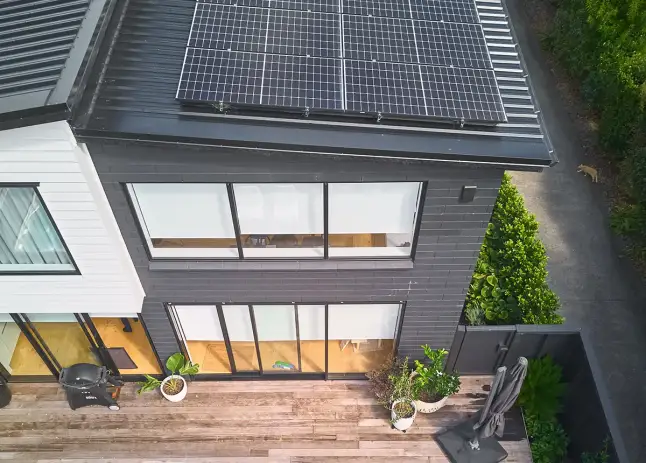
Recommended solar products
EECA has developed an approved list of solar products to help you choose quality solar panels, inverters and batteries.
The list will make it easier to find solar tech that meets our recommendations for efficiency and demand flexibility, and give you more confidence in your choices, in a growing solar market.
Add-ons to enhance your system
Your installer might suggest add-ons like an app for monitoring your solar system, a smart charger if you have an EV, or a device for optimising the use of solar for heating your hot water.
A hot water timer or solar diverter can help you save more
If you’ve got an electric hot water cylinder, including a timer or solar diverter in your install can turn it into a cheap form of energy storage. Some newer models offer these as built-in features.
These devices will heat your hot water while the sun is shining so you can make use of it later. This will save you money as heating water is a large part of most household power bills.

Next step
Ready to get an install underway?
Find out how to source and compare quotes, and what installation looks like.