
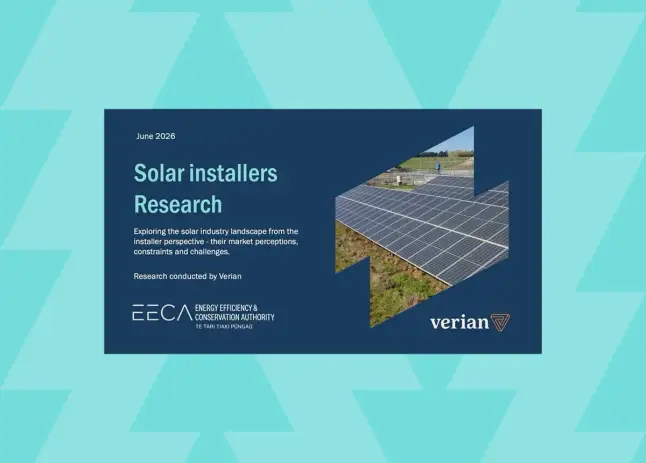
New Zealand’s solar market is growing quickly. Having enough capable installers — and giving customers confidence in the quality of their work — will be essential to supporting that growth.
EECA commissioned research to better understand the businesses installing solar across New Zealand, how prepared they are for increasing demand, and what could help the industry expand while maintaining high standards.
About the solar installers research
Verian conducted an online survey between 1 April and 6 May 2026. It was completed by 281 business decision-makers:
- 156 solar installers
- 115 electricians whose businesses do not currently install solar
- 10 solar equipment suppliers.
Why we conducted this research
EECA wanted to build a clearer picture of the solar installation market, in order to best support the industry and its solar programme. This includes:
- the size, structure and experience of installation businesses
- installers’ expectations about future demand
- the industry’s ability to take on more work
- workforce, training and information needs
- how installers source products and support customers
- attitudes towards installer accreditation
- how EECA can best support a capable, trusted solar industry.
Key findings
Installers expect demand to keep increasing
Eighty-five percent of solar installers said demand had increased over the previous 12 months, and the same proportion expected it to increase over the following year.
Rising electricity prices were the most commonly identified driver. Installers also pointed to greater public awareness, falling technology costs, interest in energy independence and the influence of friends, whānau and neighbours who already have solar.
Most installers believe they could respond to further growth: 74% felt prepared to take on more work if demand doubled over the next year. However, the remaining quarter said they were close to, or already at, capacity.
Skilled workers could become a constraint
Finding skilled staff was the most significant challenge installers expected to face if demand increased sharply.
Forty-four percent of solar installation businesses had advertised for additional staff during the previous year. Among those recruiting, 83% looking for qualified electricians and 74% looking for experienced solar installers said these workers were difficult to find.
Training existing staff, supply-chain pressures and regulatory requirements were also identified as potential constraints.
There is, however, additional capacity that could be activated. Thirty-five percent of the non-solar electricians surveyed said their businesses already had the capability to install solar. Many indicated they would consider entering the market if suitable training or support were available.
Customer confusion can slow the journey from interest to installation
Installers see strong customer interest, but say choosing a solar system can be difficult for people to navigate.
More than half said comparing quotes was a source of confusion for customers. Choosing the right system size, deciding whether to include a battery and estimating savings or return on investment were also common challenges.
This reinforces EECA’s earlier consumer research, which found that people value clear, independent information tailored to their circumstances. Better information could help customers compare their options, set realistic expectations and make decisions with greater confidence.
Installers also need accessible, up-to-date information
Installers generally felt well informed about technical installation guidance, standards and compliance. They were less confident about the latest solar products, technology and wider market developments.
Suppliers were the most common source of product and technology information, used by 82% of installers. Sixty-five percent relied on their own online research. Supplier-led training, online information and opportunities to learn from other installers were their preferred ways to build knowledge.
The findings point to an opportunity for more consistent, practical and independent information that complements the technical support provided by manufacturers and suppliers.
Accreditation is supported — if it delivers clear value
Seventy-two percent of installers considered solar installer accreditation a very or fairly good idea.
Support was mainly driven by the potential to improve installation quality, uphold safety and technical standards, and give customers greater confidence. Sixty-five percent considered improving the quality of installation work a highly valuable potential benefit, while 63% said the same about building trust in the solar market.
Next steps
The findings are helping inform EECA’s work to support high-quality installations, consumer confidence and sufficient installer capacity as New Zealand’s solar market grows.
Read next
-
Is solar right for your home?
Solar has come a long way and now offers great cost savings for most homes in New Zealand. Find out if solar is right for you.
-
Residential solar in New Zealand: The customer journey
This market research looks at the customer’s perspective of investigating, researching, financing and installing solar in New Zealand.
- Solar energy
- Market research
- Smart technology
-
Understanding the value of residential solar PV and storage in New Zealand
This research investigates the value of solar in more detail, across a broader range of conditions, than has been possible in the past.
- Solar energy
- Electricity
- Renewable energy