

Optimising actions
The biggest gains in fuel efficiency come from driver training, combined with using data and acting on it consistently.
-
Lift driver capability
Training drivers in fuel efficiency techniques is one of the most effective ways to reduce fuel use across a fleet.
-
Measure and manage fuel use
Fuel and vehicle data helps you to identify areas of fuel wastage, so you can take action and measure progress over time.
Lift driver capability through training
While taking drivers off the road can be a challenge, the payback is often rapid — sometimes within a few months — after which the savings continue.
Shorter, in-cab coaching options can also help reinforce good driving habits across your team.
If it’s been a while since your drivers did any training, a refresher could help to reinforce fuel-efficient driving habits.
-
50% co-funding for in-cab coaching with TR Driver Training
EECA is partnering with TR Driver Training to reduce the upfront cost of driver training.
This training offer is open to TR Group’s customers or drivers who work for TR Group’s customers.
We’re co-funding 50% of the cost of a 2-hour coaching session, reducing the cost to $260 +GST per driver. This funding can also go towards longer coaching sessions of 4 or 8 hours.
If your organisation offers fuel-efficient driving training and you’re interested in offering a discount to your customers, contact us at: business@eeca.govt.nz
-
SAFED NZ driver training
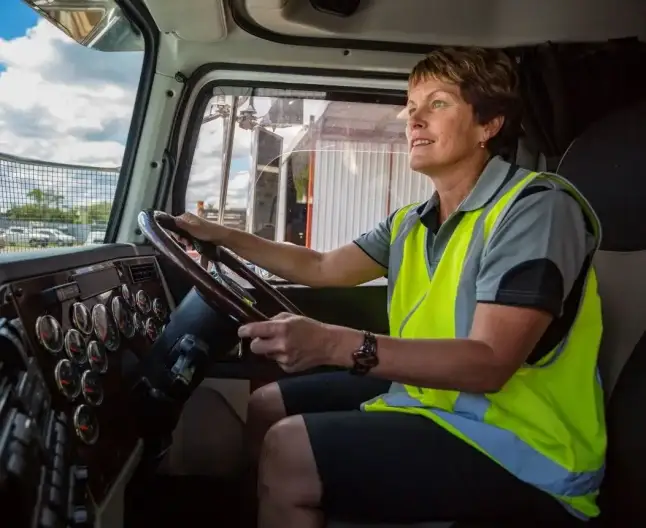
Safe and Fuel Efficient Driving New Zealand (SAFED NZ) is a comprehensive 1-day driver course for heavy vehicle drivers. Businesses that sign up often attain fuel savings of 5–10%.
- Where: Instructors are available nationwide.
- How: Mixture of in-class and in-cab training.
- Cost: Usually from $900 to $1,200 per driver, depending on the provider.
Most drivers used between 38 and 42 litres per 100 km on their first drives and reduced that to 35 to 38 L/100 km on the second. One day shift driver even achieved a remarkable 33.5 L/100 km.
Resources for your drivers
Use these resources to help remind your drivers of best practice for fuel-efficient driving.
The short tips focus on the driving habits and maintenance practices that have the most impact on cutting fuel costs for your business.
These printable posters focus on tips for driving trucks efficiently.
Measure and manage fuel use
Most fleets already collect fuel and vehicle data via telematics, fuel cards or basic tracking. It’s worth making time to use this data more actively to identify where fuel is being wasted — and act on those insights consistently.
Start by tracking fuel use at a vehicle or driver level, not just across the fleet. This makes it easier to see where performance varies and where to focus:
- Only use one fuel card per vehicle, so you can better understand each vehicle’s performance.
- Compare fuel performance across vehicles, routes and drivers.
- Track trends over time to spot changes in performance early.
- Benchmark performance using metrics like litres per 100 km, per delivery, or per tonne-kilometre.
Using consistent measures helps separate normal variation from real inefficiency — and gives you a clear baseline to improve from. You can then set targets for the fleet to meet, as well as for individual drivers.
How to get more from EROAD telematics
If you’re a fleet manager that uses EROAD telematics or you’re considering using it, this webinar recording shows you how to reduce fuel costs and maintain productivity. It focuses on monitoring fuel use, cutting idling, benchmarking performance, and using driver tools to encourage more fuel-efficient behaviour.
-
50% co-funding to optimise your fleet and save fuel
This short-term co-funding pilot provides a professional analysis of your existing fleet and telematics data to identify fuel-saving and optimisation opportunities.
- Eligibility — If you’re a private sector business with 20 or more vehicles in your fleet and you’ve got telematics data available, you are eligible to apply for this co-funding. (Government organisations are ineligible.)
- Benefits — The insights from a fleet analysis can help reduce your fleet costs and increase the overall efficiency of your operation.
View co-funding pilot for fleet optimisation
Don't have telematics data?
Our co-funding for a fleet study might be a better fit. It can help you get the most out of your fleet and reduce fuel use.
Identify issues and reinforce good performance
Once you can see the differences, you can act on them.
Identify outliers — vehicles or drivers using more fuel than expected — and investigate why. Target support towards lower-performing drivers with simple guidance, training or reminders.
Make performance visible to lift standards across the whole operation and reinforce good habits.
- Use telematics dashboards or built-in driver leaderboards.
- If you don’t have telematics, use fuel card data and kilometres travelled to create your own.
- Share results with your team and encourage improvement.
- Display results in shared spaces like dispatch offices or breakrooms.
Recognise and reward good performance to help build buy-in. This could include rewarding the most improved drivers or recognising strong performance across the whole team when targets are met.
Unless fuel efficiency is embedded within the culture of an organisation, most of the benefits of driver training and other measures may be lost as employees revert back to their old, familiar ways of doing things.
New Zealand transport industry research
Maintain vehicles for consistent performance
A well-maintained vehicle can use 10–20% less fuel than a poorly maintained one, while also improving safety and reliability.1
Check your fuel records for vehicles with unusually high consumption, as they may have an underlying maintenance issue that has not yet been identified.
Schedule regular, basic maintenance by a qualified technician, plus ensure drivers are carrying out formal weekly maintenance checks.
Plan routes and schedules effectively
For delivery operations, fuel use is determined as much by routes as how vehicles are driven.
- Use routing or logistics tools to optimise delivery sequencing and reduce unnecessary kilometres. (There are many available at various price points.)
- Minimise time spent in congestion and stop-start traffic.
- Where possible, adjust delivery windows or schedules to avoid peak congestion.
- Review run frequency with your customers to see if it’s possible to reduce unnecessary trips.
If you’re using a telematics system for route planning, talk to your telematics provider about how to get the most out of it.
If you don’t have telematics yet, ask your sector body for advice on the best-fit system for your operation, or consider an online platform that doesn’t require a real-time data feed.
Assign the right vehicle to the right job
Use your performance data to match vehicles to the work they’re best suited for, rather than what’s available.
- Deploy your most fuel-efficient vehicles on the longest or most fuel-intensive routes.
- Identify vehicles that consistently underperform and review whether they’re suited to the job.
- Newer vehicles are likely to be more fuel efficient — monitor use and fuel to verify.
-
Want to see where you’re at?
Take the Transporting New Zealand 10-minute assessment to get a quick view of your current performance and where to focus next. It’s designed around emissions, but the insights apply directly to fuel use and operational efficiency.
Next step
Build long-term resilience into your business
Steps you can take to reduce your exposure to price spikes, supply issues, and long-term uncertainty.