

While biogas is a well-established source of energy for heating and fuel overseas, New Zealand has an emerging biogas market.
Increasing biogas production could reduce emissions from waste, contribute to energy security, and increase use of renewable energy.
How much of our energy comes from biogas?
Biogas is a small part of New Zealand’s energy supply, accounting for an estimated 3% of natural gas demand in 2023 (the latest available figures).1
In 2019, 3.5 petajoules (PJ) was generated from 8 wastewater treatment plants, several industrial sites, and thirteen landfills with combined heat and power systems. This amount is similar to around half of the demand for residential gas each year.
Since then, supply has grown with Ecogas’ Reporoa facility, a new Christchurch plant in development, and several smaller anaerobic digestion projects emerging nationwide.2
In 2023, biogas production was estimated to be 4.9 PJ per year, with 18.6 PJ per year of untapped potential.3
On this page
What is biogas and how does it work?
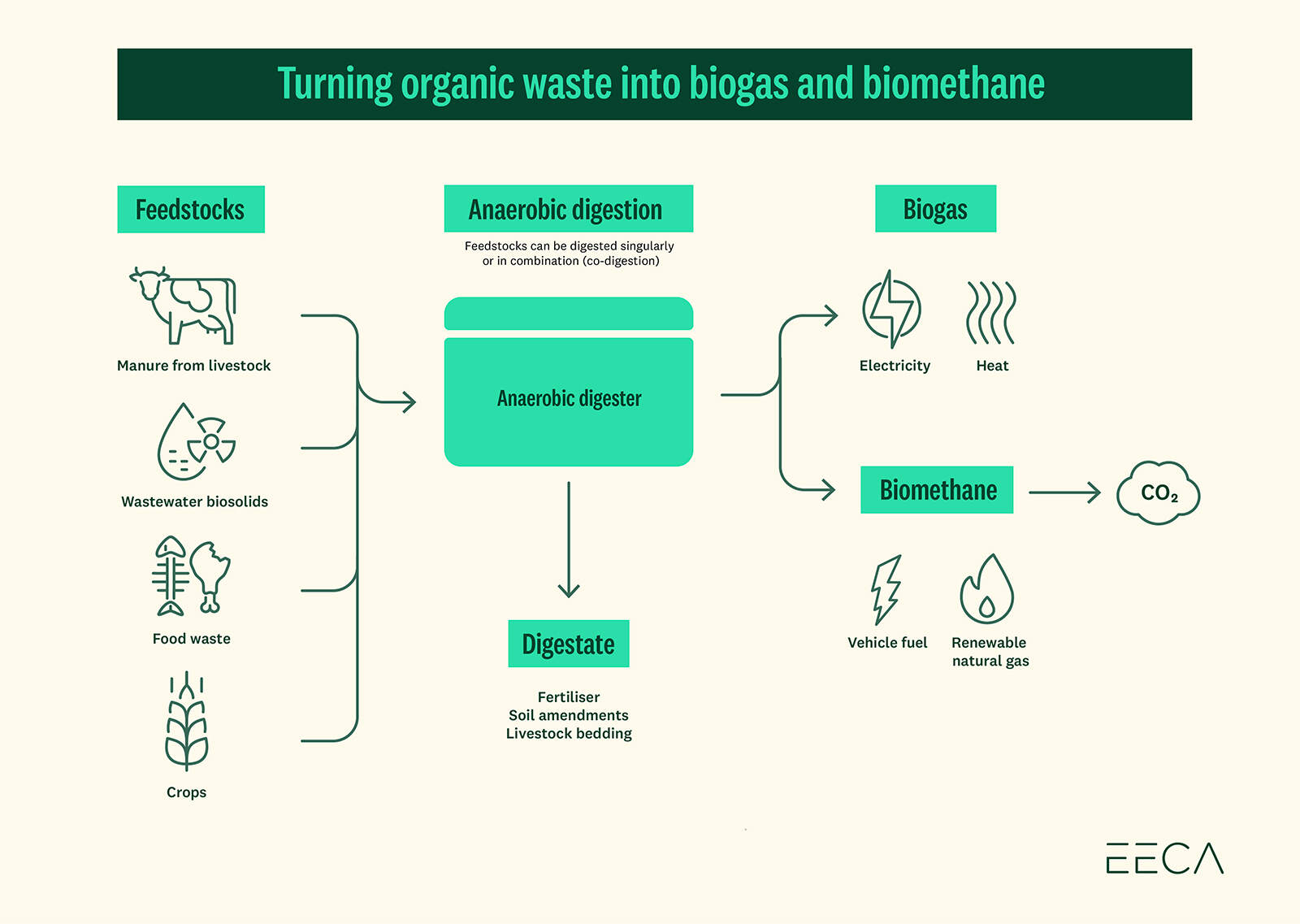
Biogas is a renewable, low-emission fuel used for direct heat and energy in onsite operations. It is created when microorganisms break down organic waste in a process called anaerobic digestion. Technologies like anaerobic digesters or landfill gas capture systems are used to convert the waste into biogas.
Common sources of organic waste for biogas (feedstocks) include leftover food, animal waste, agricultural residues, wastewater sludge, and other materials like grease.
Biogas can be upgraded to biomethane for injecting into the national gas network or using as transport fuel.
Biomethane production also creates digestate and green CO2. These co-products have various uses in the agricultural and industrial sectors.
A pioneering biogas facility
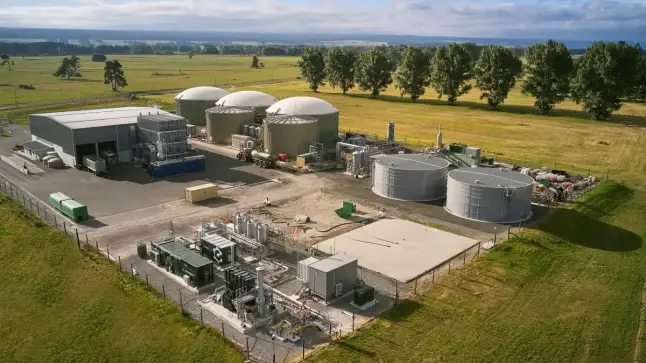
Ecogas Reporoa is the only facility operating at significant scale in New Zealand. It produces around 160 terajoules (TJ) of biogas each year, which is used:
- for electricity and heat
- to supply carbon dioxide to nearby glasshouses
- to produce biomethane for injecting into the gas network.
This output is equivalent to around 0.2 per cent of New Zealand’s piped fossil gas consumption in 2024.
-
Advantages of biogas
- Increases energy security and resilience — Biogas is a domestic energy source that can bolster energy security and regional resilience by supporting localised energy supply.
- Works with infrastructure —Biomethane is compatible with existing fossil gas infrastructure, enabling use of current assets and smoother integration into existing systems.
- Makes use of readily available organic waste — New Zealand's underutilised waste streams (manure, crop residues, and source-separated organics) could produce up to 13 PJ of biogas per year, according to industry estimates. This is broadly similar to the amount of piped gas used annually by residential and commercial customers.4
- Integrates systems — Biogas projects can integrate waste management and energy systems by converting unavoidable organic waste into useful energy and co-products.
-
Limitations of biogas
- Not suitable in all locations — Current biogas production is small, decentralised and largely site-specific. It won’t work everywhere. Biomethane largely relies on access to the gas network, limiting its use in regions without reticulated gas.
- Needs a stable feedstock supply — Access to consistent, scalable feedstock is a key constraint, with collecting and transporting it often challenging.
- Multiple factors need to come together — Anaerobic digestion facilities require suitable land and locations, infrastructure, and integration with existing energy systems.
- Regulatory and by-product requirements must be met — Compliance and handling obligations increase the complexity and cost of biogas production.
How is biomethane created from biogas?
Through a ‘scrubbing’ process, biogas is upgraded to produce biomethane. The process removes CO₂, hydrogen sulfide, moisture and trace contaminants, leaving a gas that is mostly methane.
Biomethane has the same chemical and energy properties as fossil natural gas. That means it can be injected into the North Island gas network and used to replace natural gas with no changes to equipment.
Biomethane co-products
Producing biomethane also generates additional products alongside renewable gas:
- Digestate can be reused in agriculture or land management.
- Green CO₂ can be captured for use in food, beverage and industrial processes.
These co-products can improve project economics and support a more circular energy system.
While upgrading biogas to biomethane is capital-intensive, the higher energy value, broader range of uses, and access to gas customers can outweigh these costs in suitable locations.
For organisations that already rely on gas, biomethane provides an immediate opportunity to reduce emissions while continuing to use existing infrastructure.
Which locations are best suited to biogas?
A biogas facility makes sense when there is a consistent, local supply of organic waste and nearby energy demand. Typical examples include sites close to:
- landfills
- wastewater treatment plants
- food and beverage processors
- municipal food waste collection systems (e.g. kerbside organics)
- horticultural operations with crop residues or processing waste
- farms with concentrated livestock operations and manure streams
- industrial or commercial sites with combined heat and power demand.
In regions connected to the North Island gas network, biomethane enables renewable gas to be used off site and by multiple customers.
In regions without gas infrastructure, direct on-site use of biogas for heat or electricity is more likely to be practical.
Modelling
The New Zealand Energy Scenarios (TIMES-NZ 3.0) tool helps us to identify where biogas and biomethane could provide the greatest system value, and how they might complement electrification and other renewable pathways.
While TIMES-NZ 3.0 doesn’t give forecasts, modelling is particularly important for biogas because its future role depends on feedstock availability, infrastructure access, technology costs, and competition with other low-emissions options.
Biogas is a complementary energy solution rather than a universal one, contributing where conditions are favourable.
How climate-friendly is biogas?
Biogas and biomethane can improve emissions performance by capturing methane from organic waste and using it as a fuel rather than allowing it to escape into the atmosphere.
The emissions intensity of biomethane varies by feedstock, transport distances and system design, but is generally lower than fossil natural gas.
Comparing emissions intensity
| Energy source | Emissions intensity — kg CO₂e/GJ* |
| Biomethane from anaerobic digestion | 19 |
| Biomethane from landfill gas | 10 |
| Natural gas | 57 |
|
*Kilograms of carbon dioxide equivalent per gigajoule Source: Ministry for the Environment (2024), Measuring emissions: A guide for organisations |
|
Due to minor methane losses during processing, biomethane produced by anaerobic digestion has a slightly higher emissions intensity than biomethane produced from landfill gas.
However, anaerobic digestion delivers broader system benefits by avoiding uncontrolled methane emissions that would otherwise occur if organic waste were landfilled or composted.
When avoided emissions are included, anaerobic digestion performs particularly well. Ministry for the Environment guidance estimates emissions of:
- 0.02 kg CO₂e per kilogram of waste for anaerobic digestion
- 0.175 kg CO₂e per kilogram for composting.
What is the future of biogas in New Zealand?
As domestic natural gas supplies decline and energy security becomes increasingly important, biogas presents an opportunity to provide locally produced, renewable gas that supports regional energy needs and existing infrastructure.
EECA’s role
We are supporting the development of a market-led biogas sector by working with industry, local government, iwi and other agencies. This includes:
- delivering a region-by-region assessment of organic waste feedstocks to quantify potential energy yields
- supporting evaluation of renewable energy pathways, including anaerobic digestion and biomethane.
We’re also working to identify and address barriers to biogas development, and to ensure biogas is considered alongside other energy and waste management options.
Biogas projects are typically small-scale and decentralised, which can improve local energy resilience and system flexibility.
-
Stay up to date
If you're interested in learning more about our biogas projects, sign up to EECA News for updates.