


Each year, we track the sales and energy performance of regulated products sold in New Zealand. Here are our key insights for 2025, based on data from April 2024 to March 2025.
Efficiency is improving
Overall, products are using less energy for their size. For example, TVs use less energy per inch of screen size, and fridges use less energy per litre of capacity.
This improvement is partly offset by many home appliances getting bigger. One example is the average TV screen size increasing from 37 inches in 2015 to 50 inches in 2025.
Consumers have more choices
Across all product categories, there’s been strong growth in the range of companies, brands and models available in New Zealand, giving shoppers more options to choose from.
Popular products and energy features
- Heat pump clothes dryers — These dryers accounted for 46% of new dryer sales in the year ended March 2025, up from just 10% in 2018. They’re becoming more popular as they use about half as much energy as traditional vented or condenser dryers, resulting in lower running costs. They’re also gentler on clothes, helping them to last longer.
- Smart features in washing machines — These technologies allow users to monitor and control wash cycles from their smartphones. They also optimise energy usage by adjusting wash settings based on load size and fabric type.
- Energy-efficient fridges and freezers — The average fridge or freezer sold in 2025 uses half as much energy as one sold in 2003. More people are buying fridges and freezers with higher star ratings for their homes, showing a clear shift towards more energy-efficient appliances.
- Computer monitors with high energy performance — From 2014 to 2024, sales of monitors with a rating of 7 or more stars jumped from 0.1% of sales (73,000 monitors) to 29% of sales (384,000). The biggest jump occurred in 2020, coinciding with COVID lockdowns and a shift towards people working from home.
- Low-impact refrigerants in heat pumps — Refrigerants with a much lower environmental impact are increasingly being used in heat pumps. Almost all residential heat pumps sold today use R32 refrigerant, which has a significantly lower global warming potential than the previously used R410A.
- Mains-pressure electric water heaters — Since 2020, sales of low-pressure systems have fallen by 50%, while sales of mains-pressure systems have risen more than 50%.
Energy savings achieved
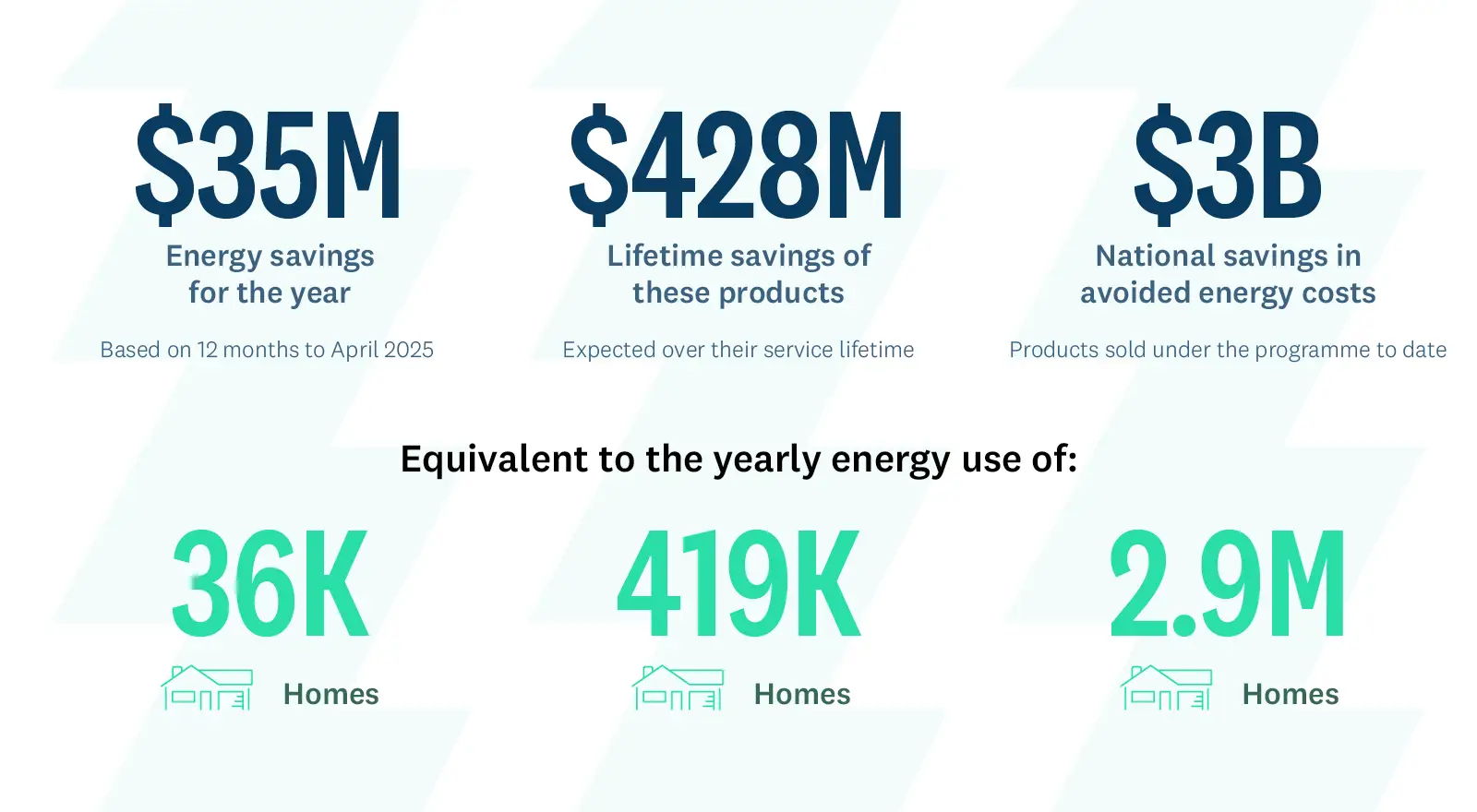
From the time EECA’s Equipment Energy Efficiency (E3) programme started in 2002, almost 110 million energy-efficient products have been sold in New Zealand, saving businesses and consumers 35 billion kWh of energy.
That equates to $3 billion of national benefits1, and 4.4 million tonnes of avoided carbon emissions.
(1. Based on avoided electricity generation calculated at $0.088 per kWh.)
Sales trends
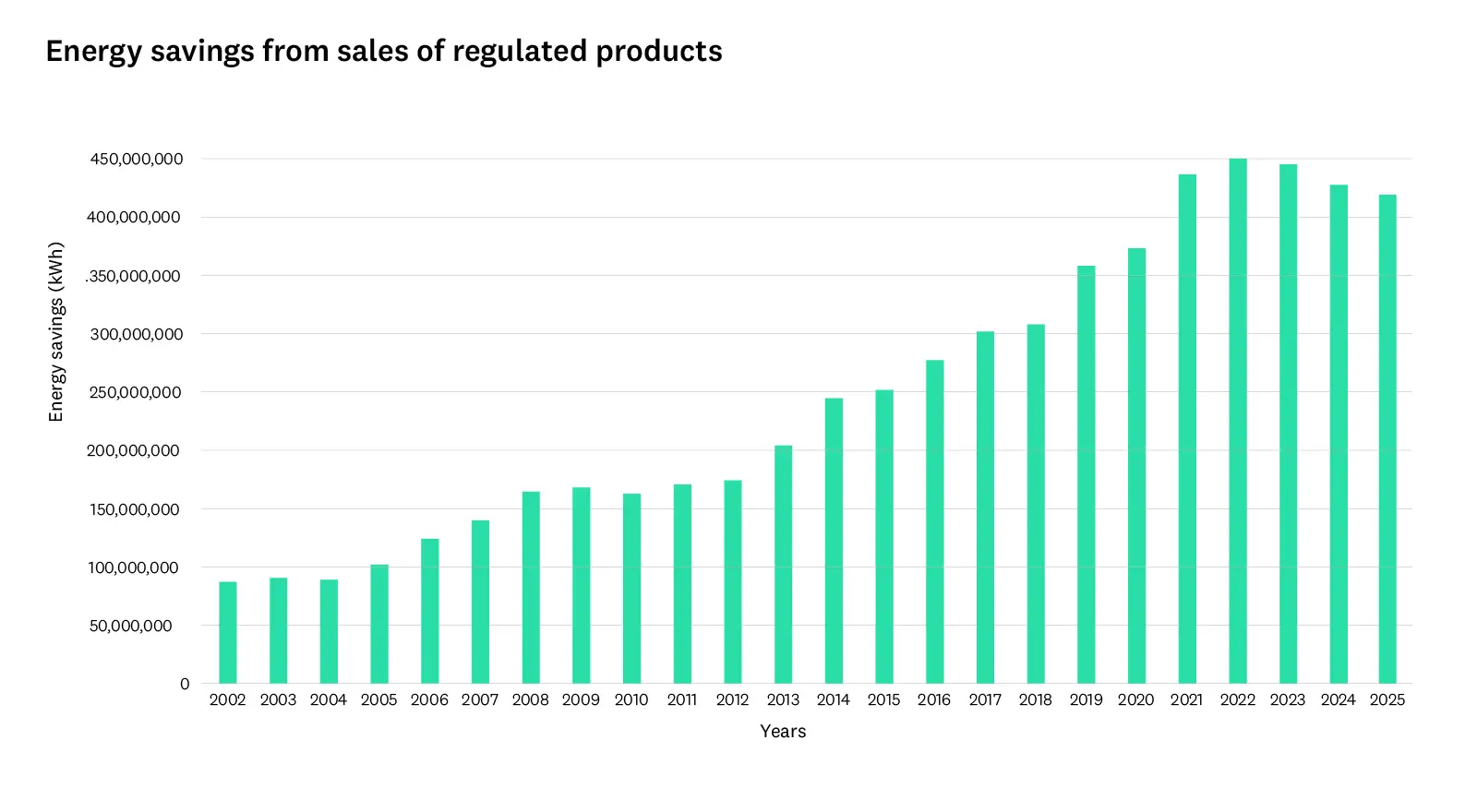
Overall sales volumes dropped across most product classes, contributing to a small decrease in energy savings and national benefits achieved in the year to March 2025.
Volumes down again for heat pumps
Sales dropped for the third time in a row, down 8% from 2024 to just 190,000 heat pumps. This may be partly due to market saturation — heat pump sales have been strong for the past 2 decades, so many people have already replaced their older heaters.
Landlords may also have already bought heat pumps ahead of the July 2025 deadline for Healthy Home Standards, which required a suitable fixed heater in the main living room of rentals.
By the time of the 2023 Census, about two-thirds of New Zealand homes already had heat pumps.
Fewer fluorescent lamps sold
A 26% decrease in compact fluorescent lamps sales may be due to this technology being superseded by more energy-efficient LEDs.
Market moving to more efficient products
Despite sales volumes dropping, the market continues to move toward more energy-efficient products. For example, almost half of all clothes dryers sold in the last year were rated at 6 to 10 stars for their energy efficiency, as they use heat pump technology.
View all sales and efficiency data
How product regulations affect running costs
EECA regulates energy-using products to help lower costs for households and businesses. Our regulatory programme ensures you have access to the best-performing products and reliable information about them.
We work closely with Australian regulators under the E3 programme. Sharing the cost of regulation makes it easier and cheaper for businesses trading in both countries to comply, and means consumers are offered a wider choice of products.
New Zealand regulations use:
- MEPS (minimum energy performance standards) to remove the worst performing models
- MEPL (mandatory energy performance labelling) to encourage consumers to buy more energy efficient appliances.
The labels display the product’s energy performance on a scale of 1 to 10 stars, with 10 being the most energy efficient.
-
Finding efficient appliances
Energy rating labels make it easy to compare the efficiency and running costs of similar appliances. The more stars, the more efficient the appliance is compared to a similar product of the same size.
With our calculator, you can easily compare labelled products in New Zealand.